
In May, the IT Innovation team attended a day of talks on AI in education, hosted by the University of Manchester in collaboration with Cloudforce and nebulaONE. As early adopters of the nebulaONE AI platform, we were keen to hear how others across the sector are approaching AI – not just as a technology, but as a force reshaping how universities teach, operate, and support their communities.
Across a packed programme of keynotes, panels and hands‑on sessions, one theme repeatedly surfaced: the evolving relationship between AI and humanity.
At times, speakers positioned AI as something that sharpens and amplifies the distinctly human aspects of our roles as educators. At others, they explored how understanding AI itself in human terms can help us design and work alongside it more effectively. This blog brings together some of the key insights from the day, and considers how that shared theme of AI and humanity arose throughout.
Collaboration, Community, and a Human-Centred Vision for AI
The opening keynote from Danny Attias (Cloudforce) and PJ Hemmaway (University of Manchester) emphasised collaboration. No single institution can solve the challenge of AI alone – success requires shared learning across universities, industry, and the public sector.
But collaboration must also go beyond these conventional relationships! The speakers framed AI, and tools like nebulaONE in particular, not as a replacement for human capability, but as something that enables it – whether by supporting neurodiverse colleagues, enhancing how students engage, or helping organisations rethink how they create value.
The message was clear: through meaningful collaboration, AI has the potential to make education more inclusive, more responsive, and ultimately more human.
Rethinking Education in an AI World
In the next session, Professor Janet Lord (Manchester Metropolitan University) addressed a fundamental question: what does higher education look like with AI as part of the landscape? She outlined three major shifts:
- Learning and assessment – As AI models become more capable of generating content, the focus moves from what students know and towards what they can do with what they know. Education increasingly centres the human qualities of creativity, judgement, and ethical reasoning.
- Role of academics and staff – For educators themselves, AI again emphasises their more human role. If AI can explain and summarise information, then the value of educators lies less in delivering answers and more in guiding thinking, fostering critical enquiry, and helping to navigate complexity.
- Governance and strategy – At the same time, institutions must be deliberate. Just because something can be automated does not mean it should be. The challenge for universities is not simply adopting AI, but ensuring its use reflects the values and responsibilities at the heart of education.
Underlying all of this was a simple but powerful message about the future of the sector and its unique strengths: AI may not have values, but universities do.
Shared Experiences: Creativity, Leadership, and Human Judgement
A series of lightning round talks brought these themes to life through real-world examples of AI adoption. We heard that:
- Organisations are being pushed to move quickly with AI, often ahead of governance – but without clear intent, speed risks exposure rather than progress.
- Alongside this, there are real human concerns around skills, confidence, and the future of work that need to be addressed openly.
- In combatting this, speakers stressed the need to understand AI as a collaborative, rather than replacement, technology – something that works with people rather than displacing them.
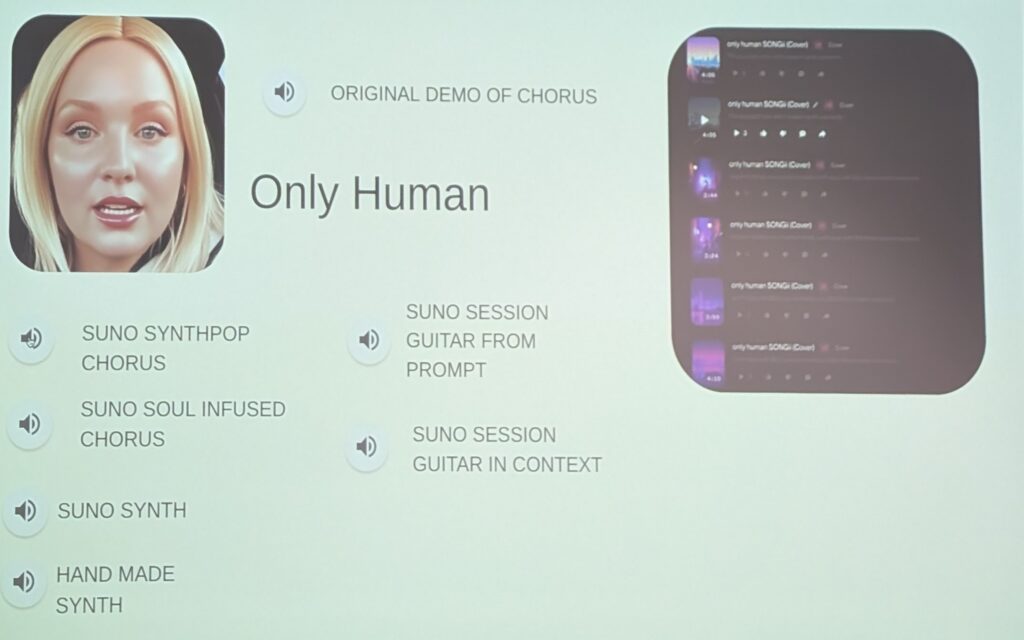
- In creative contexts especially, AI expands possibilities but still depends on human judgement, authorship, and direction. This symbiosis was encapsulated by the demo of a song, “Only Human,” that Hannah McGuigan (Royal Northern College of Music) co-wrote with the AI Music Generator tool Suno, and from which this blog takes its title!
- Designing AI systems is increasingly about designing teams – with agents acting as “digital teammates” that require structure, clear goals, and oversight.
For us as an IT Innovation Team, the session on Unit M – the University of Manchester’s own innovation team – was particularly interesting. Their “AI Pathfinder” programme’s focus on solving real problems, scaling solutions into operational use, and embedding AI access across the institution reflects a deliberate, impact-driven approach to innovation that resonated closely with our own work.
From Principles to Practice
Alongside the more strategy-focused panels, the day also covered the practical realities of working with AI.
Sessions on nebulaONE highlighted the importance of secure, flexible platforms that align with organisational governance. A “prompting best practices” workshop reinforced that effective AI use depends on clear communication – structuring problems, providing context, and setting expectations, much like when working with human colleagues.
A closing, hands-on session where we all built our own AI agents in nebulaONE brought these lessons to life. Designing prompts and workflows showed that outcomes are shaped directly by how we guide the technology. The tools are powerful, but their value depends on how we use them.
Final Thoughts
If there was a single takeaway from the Greater Manchester AI in Education Day, it is this: AI is ultimately a human story.
It challenges how we teach, how we work, and how we lead. But in doing so, it also reinforces what matters most – our judgement, our creativity, and our responsibility to one another.
As AI becomes embedded across the sector, the question is no longer whether it will reshape education. It is how we ensure it does so in a way that reflects the values we care about.