
Confirmation and Clearing: Better answers, faster calls, happier students. Here’s how.
Every year, A-Level Results Day arrives like a wave. Within hours, phones ring at the University of Birmingham’s Student Living team and thousands of students, some excited, some anxious, many calling from thousands of miles away, want answers. Fast, clear, accurate and sometimes surprisingly specific ones.
What size is my bed? Which buildings are accessible? What’s the exact room address for my visa application? How do I book my room? What colour are the walls? (Yes, really.)
For a student on the most important call of their year, none of it is trivial. And this summer, an AI agent built and deployed in just a couple of weeks meant that whoever picked up the phone had the right answer, instantly.
That matters because Confirmation and Clearing (C&C) is one of the most demanding periods in the University calendar. Over 40 staff, many of them temporary workers, fielding thousands of complex enquiries over just a few days. Before this year, getting the right answer meant searching handbooks, calling a colleague or cross-referencing a policy, all while keeping someone on the line.
This summer, something changed.
The problem every service team recognises
The challenge was never a lack of information. Knowledge exists in most teams and organisations. Expertise exists. The problem is surfacing the right answer, for the right person, at the right moment. In previous C&C periods that gap created a bottleneck, with senior staff becoming the go to for answers that could have been available to everyone.
Built in weeks, not months
Collaborating with the Student Living team and the University’s Innovation Team, ASK: Student Living Confirmation and Clearing Assistant (Accommodation Support and Knowledge) was developed on BirminghamAI, the University’s institutional AI platform, in just a couple of weeks. The agent was made available to staff working on C&C, allowing them to quickly find the answers to questions they received. And it was built using what the team already had: handbooks, training documents, existing websites, accessibility guides, and over 7,000 anonymised enquiry records from previous C&C periods, alongside the knowledge of people who had worked through Confirmation and Clearing before.
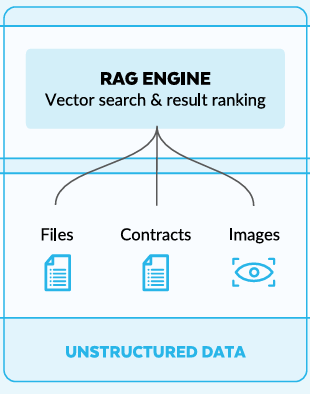
This easy to set up approach has a name: ‘RAG’, or ‘Retrieval-Augmented Generation’. Rather than relying on a general AI model’s broad knowledge, a RAG agent searches your own approved sources to shape an accurate, contextualised response. Think of it as giving your AI a curated library of everything your team knows and teaching it to find the right page, instantly.
No new data was created. The answers already existed. The AI agent simply made them accessible.
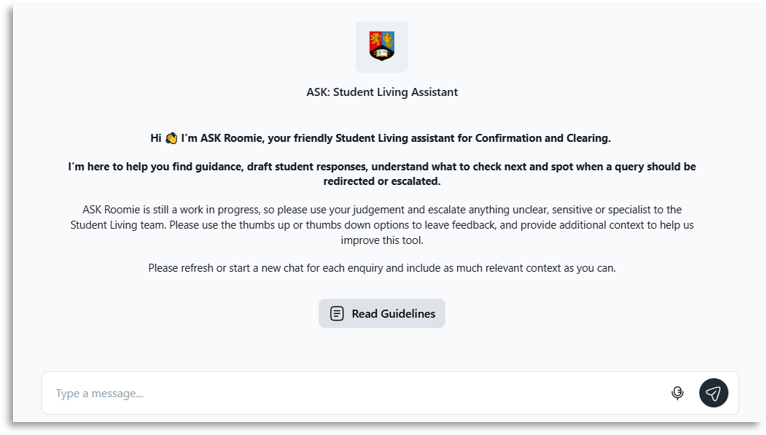
What it meant in practice
During C&C 2026, the AI agent recorded over 1,400 interactions with staff members across three days. 84% of calls were answered within 60 seconds, the lowest queue time in Student Living’s history, with escalations at their lowest ever level.
The detail behind those numbers matters. International students needing precise visa information, accessibility queries, room specifics, all answered accurately and instantly regardless of who picked up the phone. Consistency, at scale, under pressure.
Temporary and newer staff, who would previously have leaned on team leaders, were able to work independently and handle queries they wouldn’t have felt confident taking on before. The AI agent didn’t replace expertise. It distributed it.
“This has been a game changer for our team. It has made our jobs easier, improved the support we provide to students, and helped create a more confident, knowledgeable and efficient workforce.”
Sandy Csizmadiova, Manager of Call Centre Operations
Importantly, the AI agent also knew its limits. Escalation triggers for welfare, safeguarding and financial hardship were built in from the start. Every case that needed a human got one. Zero unsafe responses throughout.
The bigger picture
The knowledge already existed, in handbooks, spreadsheets, websites and the experience of the people doing the job. The AI agent didn’t create value from nothing. It made existing value accessible at the point of need. The people closest to the problem were best placed to shape what it needed to know, and that’s a model that can be replicated quickly, in almost any team.
Ready to start building?
The University of Birmingham recently launched BirminghamAI to support exactly this kind of responsible, high impact AI adoption. If you’re thinking about where AI could create real value for your teams and the people you serve, the starting point is simpler than you might expect. Visit the BirminghamAI Support Hub to find out more, or get started with bAI straight away.
The answers are probably closer than you think. With AI agents, the opportunity is in getting them to the right person at the right moment.